
Namibia has some of the darkest skies on Earth. Few people, very little light pollution and dry desert air mean that on a clear, moonless night you'll see thousands of stars, the Milky Way bright enough to cast a shadow, and two neighbouring galaxies with the naked eye. This guide to stargazing in Namibia covers the best places, the best time of year and month, what you'll see, and how to sleep under the stars.
Stargazing at a glance
- Best place: the NamibRand Nature Reserve, Africa's first International Dark Sky Reserve
- Best months: May to October, the dry season, for the clearest skies
- Best nights: the week either side of the new moon
- Milky Way core: highest in the evening sky from about June to August
- Don't miss: a night on a rooftop skybed or a dune
Why Namibia's skies are so dark
Namibia is one of the least densely populated countries in the world, and outside a handful of towns there are very few lights. The air in the desert is dry and clean, with little dust or humidity to blur the view. Many areas are also at high altitude, which means less atmosphere between you and the stars. Astronomers have noticed too: Namibia is home to major research telescopes in the Khomas Highland, chosen for the quality of its skies.
In 2012, the NamibRand Nature Reserve, a large private reserve south of Sossusvlei, became Africa's first International Dark Sky Reserve. Its lodges keep outdoor lighting to a minimum so that the night sky stays as dark as possible.

The best places for stargazing
Dark Sky Reserve
NamibRand and Sossusvlei
The darkest skies in Namibia, with lodges that offer telescope evenings and sleep-out decks. Combine stargazing with sunrise in the dunes. Read our Sossusvlei and Deadvlei guide.
Granite and stars
Spitzkoppe
Camp among the boulders and photograph the Milky Way framed by the famous Rock Arch. See our Spitzkoppe guide.
Wild and remote
Damaraland and the Kunene
Some of the most remote lodges in Africa, with rooftop sleep-outs and no light for many kilometres. See our Damaraland travel guide.
The south
Fish River Canyon and the Kalahari
Wide horizons, clear winter skies and very few people. A clear night at the canyon is unforgettable. See our Fish River Canyon guide.
Etosha is excellent too, especially at the floodlit camp waterholes, but the lights there are for watching animals, so walk away from them for the best view of the sky.
What you'll see
| Sight | When to look | What it is |
|---|---|---|
| The Milky Way core | Evenings from about March to October, highest around June to August | The bright centre of our own galaxy, stretching across the sky |
| The Magellanic Clouds | Visible most of the year, best on spring and summer evenings | Two small neighbouring galaxies, seen as faint misty patches |
| The Southern Cross | Best in the evening from about April to June | The famous constellation that points towards the south celestial pole |
| Scorpius | Winter evenings, overhead from about June to August | A large constellation shaped like a scorpion, with the red star Antares |
| Planets and shooting stars | Throughout the year | Bright planets, satellites and regular meteor showers |
When to go
The dry season, from May to October, brings the most reliably clear skies. Winter nights, from June to August, are long and very dark, with the Milky Way core high overhead, but they are also cold, often close to freezing in the desert. In the green season, from December to April, afternoon storms can bring cloud, though the skies often clear after rain and the air is very clean.
The moon matters more than the month. Plan your desert nights for the week either side of the new moon. Around full moon, the desert is beautiful in a different way, lit silver, but most stars disappear. Check a moon calendar before you book.
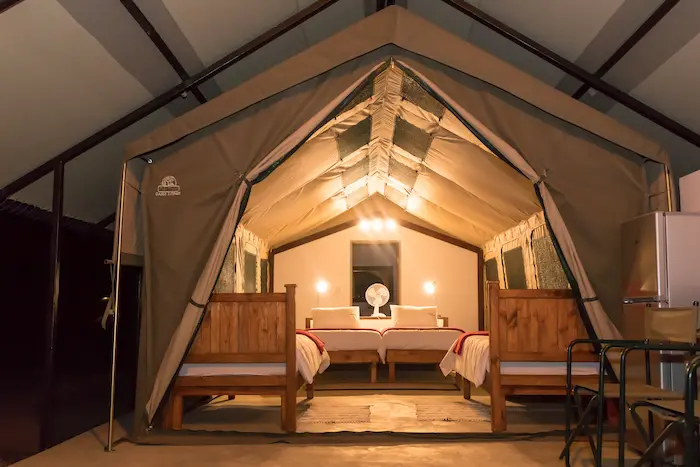
Sleeping under the stars
Several Namibian lodges let you spend a night outside on a rooftop deck or a raised platform, with a proper bed, warm bedding and nothing between you and the sky. Some have skybeds near Sossusvlei, others have small camps on top of dunes or rooftop beds in Damaraland. It's one of the most memorable experiences in Namibia and is often offered as an extra night during your stay. Our things to do in the Namib Desert guide includes some of the best options.
Photographing the night sky
- Use a tripod and a wide-angle lens at its widest aperture.
- Start with 15 to 25 seconds at ISO 3200, then adjust.
- Focus manually on a bright star, and use the camera's timer to avoid shake.
- Add a foreground: a tree, a dune or a rock arch makes the photo.
- Phones work too: use night mode with the phone resting on something steady.
For more camera tips, see our Sossusvlei photography guide.
What a night under the stars is like
After dinner, you walk up to your sleep-out deck or skybed, where the bed is made with thick duvets and hot-water bottles in winter. The lights go out and, for a few minutes, everything seems black. Then your eyes adjust, and the sky slowly fills with stars until the Milky Way arches overhead. You may hear jackals calling in the distance, or nothing at all. Most people fall asleep watching shooting stars and wake to a pink desert sunrise. Bring a warm hat and keep your torch and a jacket within reach.
Stargazing with children
Children love Namibia's night sky. Start early in the evening, before they get tired, and look for easy targets: the Southern Cross, a bright planet or a passing satellite. A simple star app helps them find constellations, and many lodges' guides tell the old stories behind the stars. Pack warm clothes and blankets, as desert nights get cold quickly.
For the best experience, book your sleep-out for your second night at a lodge, once you've seen how cold the evenings get and know what to wear.
Finally, give yourself more than one clear night if you can. Weather can change, and a second chance often brings the best views of the trip. A three-night stay in the desert, timed with the new moon, is ideal for anyone who wants to make the most of Namibia's skies.
Tips for stargazing in Namibia
- Dress warmly: pack a warm jacket, hat and gloves, even in summer.
- Let your eyes adjust: it takes about 20 minutes to see the faintest stars. Use a red torch and avoid looking at your phone.
- Download a stargazing app before you go, as there's often no signal in the desert.
- Join a guided session: many lodges have a telescope and a guide who knows the southern sky.
- Watch your step: scorpions and other small animals are active at night, so wear closed shoes.
We'll plan your route around the new moon and book the lodges with the best night skies. Explore our Namibia tours.
Frequently asked questions
Where is the best place for stargazing in Namibia?
The NamibRand Nature Reserve, south of Sossusvlei, is Africa's first International Dark Sky Reserve. Spitzkoppe, Damaraland and the Fish River Canyon are also excellent.
When is the best time for stargazing in Namibia?
May to October brings the clearest skies, with the Milky Way core highest from about June to August. Plan for the week either side of the new moon.
Can you see the Milky Way in Namibia?
Yes. On a clear, moonless night away from towns, the Milky Way is bright and clearly visible across the sky.
Can you sleep under the stars in Namibia?
Yes. Several lodges offer rooftop skybeds, dune-top camps or sleep-out decks with proper beds and warm bedding.
What should I wear for stargazing in Namibia?
Dress warmly, as desert nights are cold, especially from May to September. Wear closed shoes and bring a red torch.
Plan a trip under the stars
We'll plan your route around the new moon and book lodges with the darkest skies.
WhatsApp Us Explore Namibia Tours