
At sunset, the strange, branching silhouettes of the quiver trees glow gold against a red sky, and after dark they stand like sculptures under a sky full of stars. The Quiver Tree Forest near Keetmanshoop is one of southern Namibia's most photogenic sights, and the perfect stop on the long road between Windhoek and the Fish River Canyon. Here's what to see, when to go and what else to do in the area.
Quick answer
- Where: about 14 km north-east of Keetmanshoop, in southern Namibia
- What: a stand of around 250 quiver trees, a type of giant aloe, protected as a national monument
- Nearby: the Giant's Playground rock formations, a few kilometres away
- Best time: sunset and sunrise, and at night for star photography
- Ideal stay: 1 night in or near Keetmanshoop
What is a quiver tree?
Despite its name, the quiver tree, or kokerboom in Afrikaans, is not a true tree but a giant aloe. It grows slowly in the dry, rocky south of Namibia and the north of South Africa, and can reach several metres in height, with a thick trunk, golden flaking bark and branches topped with spiky leaves. The name comes from the San people, who are said to have hollowed out the soft branches to make quivers for their arrows.
Quiver trees usually grow alone or in small groups, which is why a whole "forest" of them is so unusual. The trees near Keetmanshoop grow together across a rocky hillside, some of them estimated to be a few hundred years old. In winter, around June and July, they produce bright yellow flowers that attract birds and insects.
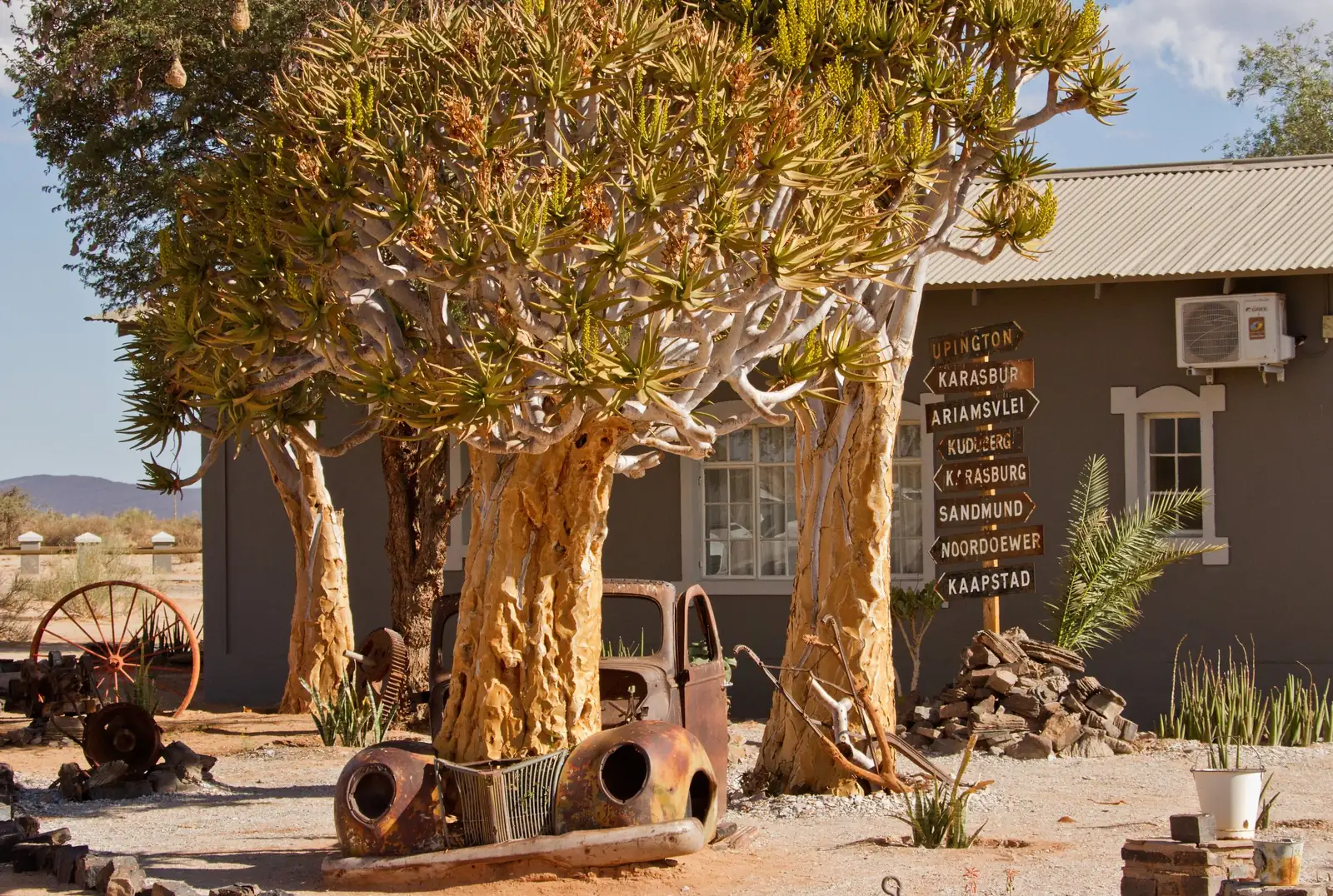
Visiting the Quiver Tree Forest
The forest is on private farmland just outside Keetmanshoop, with a small entrance fee and a rest camp with chalets and camping. You're free to walk among the trees on short paths. The best light is in the hour before sunset and just after sunrise, when the trunks glow and the shadows stretch across the rocks. Most visitors spend an hour or two, but photographers often return after dark.
The Giant's Playground
A short drive from the forest, the Giant's Playground is a jumble of huge, rounded dolerite boulders, stacked as if a giant had been playing with building blocks. They formed millions of years ago when molten rock cooled underground and was slowly exposed by erosion. A marked walking trail leads through the rocks, and it's a fun place to explore with children. Go early or late to avoid the heat.
Photographing the quiver trees
- Sunset silhouettes: place a tree against the brightest part of the sky and expose for the sky.
- Golden hour: shoot with the sun behind you to bring out the colour of the bark.
- Night sky: on a moonless night, the Milky Way rises above the trees. Use a tripod and a wide lens. See our guide to stargazing in Namibia.
- Light painting: a soft torch beam on a trunk for a second or two during a long exposure adds detail without spoiling the stars.

Things to do in and around Keetmanshoop
History
Keetmanshoop town
A quiet town on the B1, with a handful of colonial-era buildings, including the old imperial post office and a stone mission church that now houses a small museum. A good place to refuel and stock up before heading south.
Volcano
Brukkaros
An extinct volcanic crater rising from the plains north-west of Keetmanshoop. A hike to the rim rewards you with wide views over the south.
Fossils
The Mesosaurus fossil site
On a farm north-west of town, guided tours show fossils of Mesosaurus, a small reptile that lived around 270 million years ago, important evidence that Africa and South America were once joined.
Water in the desert
Naute Dam
A large dam south-west of Keetmanshoop, popular for birdwatching and picnics, with a recreation area on its shore.
When to visit
| Months | Conditions | Good for |
|---|---|---|
| May–September | Mild days, cold nights, clear skies | Photography, stargazing and yellow quiver tree flowers in mid-winter |
| October–November | Hot days | Early-morning and late-afternoon visits |
| December–April | Very hot, occasional storms | Dramatic skies; avoid the midday heat |
Getting there
Keetmanshoop is about 500 km south of Windhoek on the tarred B1, roughly five to six hours' drive. The Quiver Tree Forest is a short drive out of town on a gravel road. Keetmanshoop is also where the B4 turns west to Aus and Lüderitz and Kolmanskop, and it's about two hours from the Fish River Canyon, so it fits naturally into a southern Namibia route.
A southern Namibia route
| Day | Route |
|---|---|
| Day 1 | Windhoek to Keetmanshoop; sunset at the Quiver Tree Forest |
| Day 2 | Giant's Playground in the morning, then to the Fish River Canyon |
| Day 3 | Canyon viewpoints at sunrise, then west to Aus and the wild horses |
| Day 4 | Lüderitz and Kolmanskop ghost town |
| Days 5–6 | North through the Namib to Sossusvlei |
Why the quiver tree matters
Quiver trees are perfectly built for the desert. Their thick, soft trunks store water, their pale bark reflects the sun, and their branches shed leaves and even whole limbs during long droughts to save water. They also support wildlife: sociable weaver birds sometimes build huge communal nests in their branches, and sunbirds, bees and other insects feed on the flowers in winter. In some parts of their range, quiver trees are under pressure from hotter, drier conditions, which makes protected stands like this one even more important.
Where to stay near the forest
The rest camp at the forest has chalets and campsites, so you can step out among the trees at sunset and sunrise. Keetmanshoop itself has guesthouses and hotels, about a 15-minute drive away. Book ahead in the school holidays, when the south is busier with self-drive travellers heading to the Fish River Canyon.
Is it worth the detour?
Yes, if you are driving through the south. The forest is only a short drive from the main B1 road, and an overnight stop breaks up the long journey from Windhoek to the Fish River Canyon or Lüderitz. Photographers and stargazers often rate it as one of the highlights of their trip, and the quiet, wide-open landscape gives you a real sense of how empty and beautiful southern Namibia is.
Tips for your visit
- Stay overnight to see the trees at both sunset and sunrise.
- Don't touch or climb the trees: they grow slowly and are easily damaged.
- Wear closed shoes: the ground is rocky and scorpions shelter under stones.
- Bring a warm jacket for night photography in winter.
- Fill up with fuel in Keetmanshoop before heading further south or west.
We'll plan the south around the light, the canyon and the coast. Read our Namibia packing list, and explore our Namibia tours.
Frequently asked questions
Where is the Quiver Tree Forest?
The Quiver Tree Forest is about 14 km north-east of Keetmanshoop in southern Namibia, roughly five to six hours' drive south of Windhoek.
What is a quiver tree?
The quiver tree, or kokerboom, is a giant aloe, not a true tree. The San people are said to have used its hollowed branches as quivers for their arrows.
When is the best time to visit the Quiver Tree Forest?
Sunset and sunrise give the best light, and moonless nights are ideal for star photography. May to September is cooler, and the trees flower in mid-winter.
What is the Giant's Playground?
A landscape of huge, stacked dolerite boulders a short drive from the Quiver Tree Forest, with a walking trail through the rocks.
How long do you need at the Quiver Tree Forest?
An hour or two is enough for a walk, but staying overnight lets you see the trees at sunset, at night and at sunrise.
Can you combine the Quiver Tree Forest with the Fish River Canyon?
Yes. Keetmanshoop is about two hours from the Fish River Canyon and on the road to Lüderitz, so it fits easily into a southern Namibia route.
Plan your southern Namibia route
We'll combine the Quiver Tree Forest, the Fish River Canyon and Lüderitz into one trip.
WhatsApp Us Explore Namibia Tours